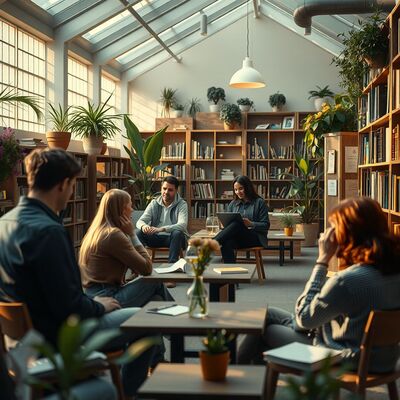

⚡ Life is moving faster than ever. But here’s the truth: we’re not machines.
As humans, we crave something different:
<3 safety
<3 community
<3 meaning
In the final part of my series, I explore how we can make the 21st century more human again. Not by rejecting progress, but by choosing balance.
Small steps matter:
– turning off notifications at night
– sharing your “best moment of the day” at dinner
– saying thank you at work
– creating spaces for real dialogue in your community
These changes start with us — but they ripple outward.
Maybe you feel it too: we can’t keep up with the pace. We measure ourselves against machines, while as humans we long for something entirely different — safety, community, meaning. The good news is: these are not unreachable dreams. They are things we can consciously weave back into our lives. In this final part, we’ll talk about how to build a more human 21st century — at the level of individuals, families, workplaces, and societies.
In the first two parts we saw how individual wounds and collective deficits are intertwined. Freud spoke about repression, Bowlby about the absence of safety, Maslow and Rogers about conditional acceptance, van der Kolk and Siegel about the body’s imprints. Jung highlighted the loss of rituals, Frankl the hunger for meaning, Yalom the existential isolation, and social psychologists the fragmentation of communities. Their shared message: human connection is not a luxury, but a basic condition.
So how do we step out of this? What are the first small steps we can already take today? And what would a society look like if these insights became guiding principles?
The problem is not that life is faster — but that we’ve forgotten to pause and reinvent ourselves. Important anchors have been lost: rituals, community practices, safe frameworks.
These are not relics of the past but universal human needs that still matter today. Many structures of the past were outdated, yes — but the speed of change left us no time to recreate what was essential. That’s why the work now must begin: with awareness, responsibility, and collective imagination.
What might this look like in practice?
- Individual level: make daily self-reflection a habit: “Who am I without my roles and strategies?” Try drawing a small boundary — no notifications after 9 PM, or spending your first waking hour in a ritual instead of on your phone.
- Family level: create new repeating rituals — a weekly dinner, an evening “best moment of the day” round, or a monthly family check-in where everyone shares what felt good and what was hard. These small rituals normalize unconditional presence.
- Workplace level: support psychological safety — a culture where mistakes, questions, and gratitude are allowed. Normalize boundaries: working until midnight is not heroism, but burnout risk. Build shared projects — volunteering, learning together — so work is more than production.
- Societal level: invest not only in physical spaces (parks, libraries) but fill them with living content: dialogue circles, shared learning, workshops. In education, emotional intelligence and self-knowledge should be core subjects — because the lack of these skills is one of the roots of our collective suffering. Access to self-knowledge is not a luxury, but a human right.
The call for change
The path is not about waiting for decision-makers to fix things. The need for change must be born within us, and from there it can spread to our communities. Technology, information, and efficiency can remain — but alongside them, space must be made for what makes us human: connection, meaningful life, and authenticity.
This is the societal parallel to what we must also do individually: ask Who am I? How do I relate to myself and others? What imprint do I leave through my thoughts, words, and actions?
If we take these steps, change will begin not only in our own lives but also in our communities. If you’d like clarity about the old beliefs and strategies that hold you back, and want to build new anchors, let’s work on it together. Because change begins here: in you, in me, and in how we shape the world together.
Send me a message and I’ll call you back. There is a way out of the maze of burnout and loneliness — let’s map your path together.
Kiemelt szakemberek a témában
-

Szalkai Réka
Pszichológus
-

-
-

-
-
-
-

Dengyel Kinga
Klinikai szakpszichológus, Környezetvédelmi szakpszichológus
-
-
Kiss-Tóth Petra
Pszichológus, Szervezet és vezetőfejlesztő és munkapszichológia szakpszichológus
Budapest és Pomáz
-
-
-

-

-
-

-

-
-
-

-
-
-

-
Komment írása